I was asked to redesign a PDF.
I ended up replacing the front end.
- Role
- Product design
- User research
- Front-end
- QA and iteration
- Stack
- Vercel
- Salesforce backend
- Sector
- Partial property sales
- Market
- Austria
- Germany
The situation
Sell and Stay sells partial property sales to retirees in Austria and Germany. Every deal starts the same way: an offer document carrying the customer’s details, their property valuation, tiered payout models and worked example calculations.
Producing one took 35 to 40 minutes. A rep pulled the data out of Salesforce, ran the tier calculations in Excel, copied the results into a Word template by hand, fixed whatever formatting broke on the way in, sent it for approval, exported a PDF and emailed it. The brief I was given was to make the Word template look better.
The turn
The template wasn’t the problem. The document was the last step in a process that leaked time at every handoff, and every one of those handoffs was a person retyping something a system already knew. A better-looking Word file would have improved the output and changed nothing about the 35 minutes.
So I proposed building the thing that produces the document instead.
 Salesforce
 Excel
Excel Word
Word Gmail
Gmail Drive
Drive WhatsAppSalesforceData layer
Why the front end is custom and the backend isn’t
Iteration speed
The sales team sits down the hall. A change I own ships the same afternoon; a Salesforce change request goes to external developers and lands weeks later.
Workflow fit
Salesforce is built for a generic sales motion. Ours runs on property valuations, tier models and two countries’ contract rules. Configuring a generic tool into that shape gets you almost-right everywhere.
Separation of risk
The data stays in Salesforce, with developers and proper controls. The presentation layer changes weekly — so that’s where fast iteration belongs, and where a mistake is recoverable.
What it does
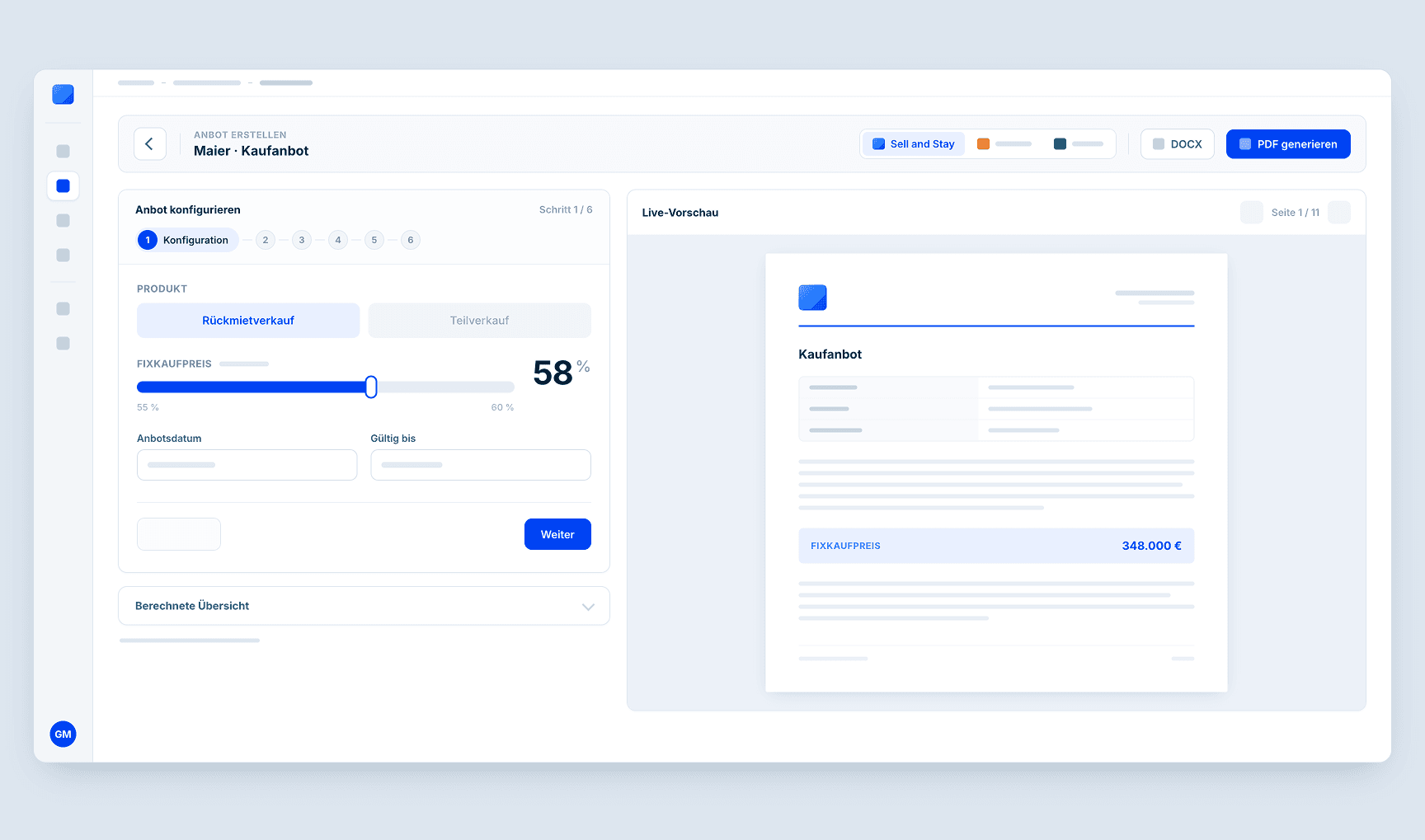
The Cockpit talks to Salesforce as a backend and handles the whole offer in one place.
- 01Pulls customer and property data automatically — no retyping, no copy-paste
- 02Runs every tier model, example calculation and payout scenario in the background
- 03Generates the finished PDF directly, with no Excel or Word in the loop
- 04Exports and sends from the tool, with the customer email pre-filled
In progress: a daily funnel screen that walks a rep through their day task by task. Planned: invoicing and payment reminders.
What it’s becoming
The offer generator was the wedge. What has shipped since:
- 01Automated emailDynamic placeholders, replacing the manual Gmail templates
- 02Suggested templatesMatched to the current deal stage, plus scheduled sending
- 03Follow-up loopsUnreached leads generate call tasks automatically
- 04Activity loggingSynced back to Salesforce, so the data layer stays authoritative
The direction is deliberate. Salesforce becomes a stable backend database managed by developers; the entire working surface is built in-house and AI-assisted. That split is what makes short feedback cycles possible without taking on structural risk.
A custom front end owned by one person is a bus factor of one. The architecture is the mitigation — the data lives in Salesforce regardless — but it’s a real tradeoff, and one I’d revisit as the team grows rather than pretend away.